
Packet Switching
"I insisted that we used distributed control – I wanted to be sure that no one node controlled the entire network. It was too vulnerable; it would be too loaded, too busy, and very inefficient. So the idea of distributed control came out of my desire to look into large network design,
and that was exactly what we needed to launch something as big as the Internet."
-Leonard Kleinrock, 3/13/13
In order for a distributed network to be possible, a method called packet switching replaced circuit switching.
Circuit Switching
 Click to enlarge A direct connection; inefficient, wasteful of bandwidth, and costly.
|
Packet Switching
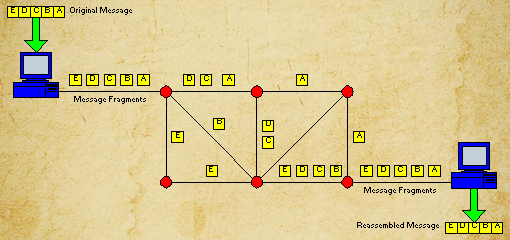 Click to enlarge Data is split into "packets" that find their way to their destination through a series of nodes.
|
Safety in packet switching
With this reliable system, a message finds its destination via any available route.
In video: Robert E. Kahn: Engineer and computer scientist at BBN (at time of video). Internet pioneer, Turing Award winner, and inventor of TCP/IP. |
"…the real underlying change was packet switching for which I was the primary designer and founder. Len Kleinrock provided me with the theory to understand queuing and be sure I could make it work."
- Larry Roberts, 3/21/13
Packet switching is the foundational concept behind computer networking. Without it, networks would be completely inefficient, and there would be no Internet.
